Travel eSIM for airlines
Airlines own one of the most valuable moments in international travel: the time between booking a flight and arriving at the destination.
Passengers are preparing for the whole trip, checking documents, sharing plans with loved ones, downloading maps, arranging transfers and looking for a reliable internet connection.
A travel eSIM for airlines turns that moment into a useful branded service. With Alphacomm, airlines can offer prepaid mobile data, destination-specific data plans and global plans directly through the booking journey, airline app, loyalty programme, check-in flow or post-purchase emails.
Passengers can easily purchase an eSIM online before departure, install the eSIM in minutes, and connect automatically when they arrive. Your airline adds a relevant digital service without managing carrier networks, mobile networks or telecom infrastructure alone.
Launch a branded eSIM offer under your airline brand
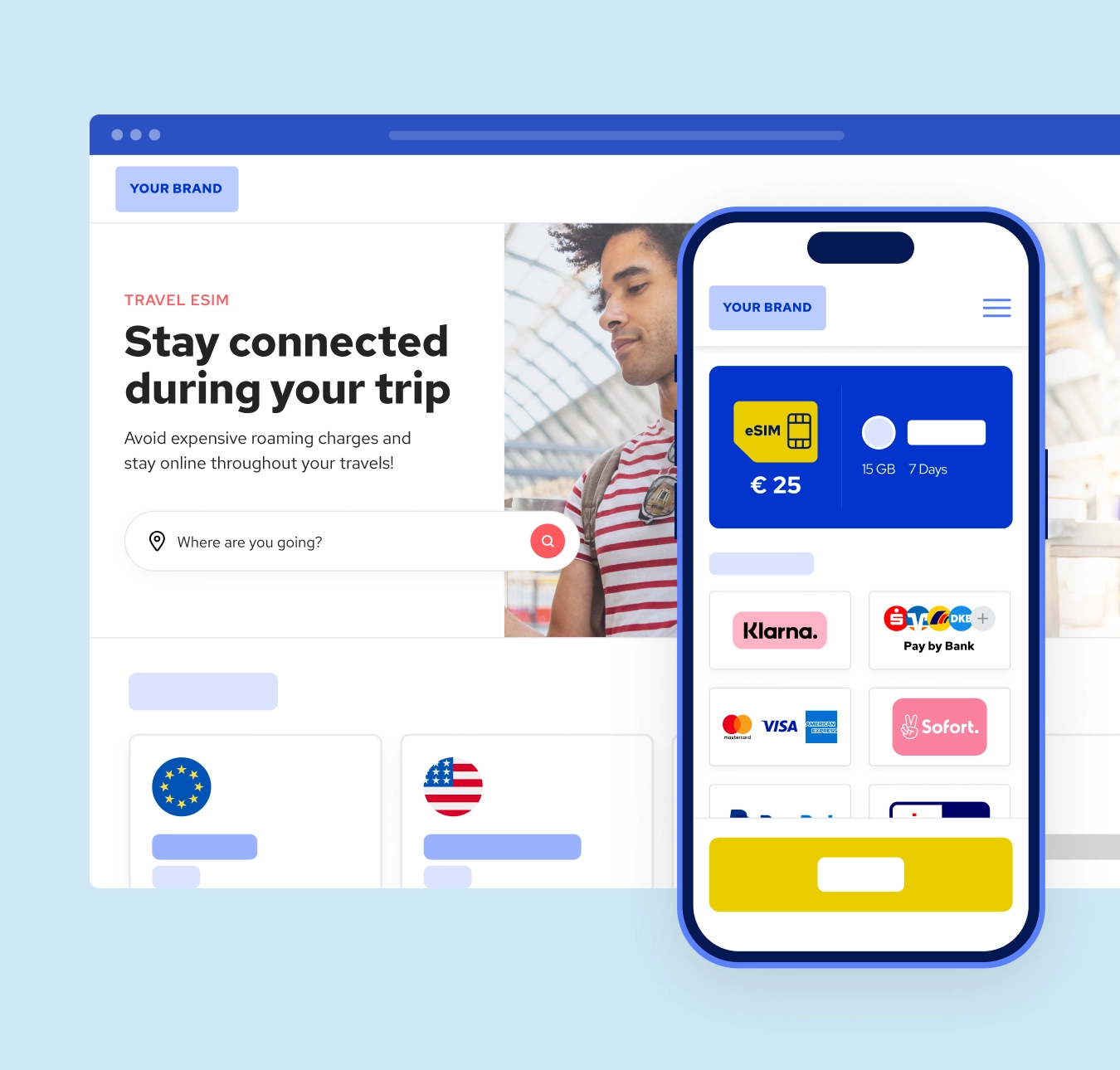
Alphacomm helps airlines launch branded travel eSIM products for international travel. We provide the eSIM platform, payment flows, fraud prevention, provisioning, support eSIM operations and digital delivery layer.
Your passenger chooses a country or destination, selects a plan, completes the purchase, receives a QR code or activation link, and installs the eSIM before the flight. When the passenger lands, the phone can connect to a local mobile network and provide instant internet access.
This gives your airline a useful digital sim card offer that fits naturally into the journey. It also creates a new plan-based revenue stream around connectivity, mobile internet and data usage.
Why airlines should offer travel eSIM now
Passengers already need data when traveling abroad. They use Google Maps, messaging apps, banking apps, hotel apps, ride-hailing tools, translation services, travel insurance, boarding updates and airline notifications.
Without a travel eSIM, they often rely on expensive roaming charges, public Wi Fi, a local sim, or a physical sim card bought after arrival. Each option creates friction.
A travel eSIM solves the problem earlier. It gives passengers mobile data before they leave, without asking them to find a sim card at the airport or adjust phone settings under stress.

A better passenger experience after landing
When a passenger lands, connectivity matters immediately. They may need to message loved ones, receive SMS codes, open Google Maps, contact a transfer provider, check hotel details or use the airline app for baggage updates.
A travel eSIM helps passengers stay connected from the moment they arrive. Instead of searching for airport Wi Fi or paying data roaming charges, they use prepaid eSIM data through supported carrier networks.
This improves customer satisfaction while your airline brand is still part of the experience. The passenger has just flown with you. Helping them connect is a natural extension of the journey.
Build your eSIM business your way

Core
Live in 4 weeks
We launch your branded travel eSIM shop, including:
Your own branded URL
Effortless eSIM proposition
Premium global connectivity
Fully managed operations
Multi-language and multi-currency built-in
Support for vouchers
Dedicated CSM
No set-up or monthly fees
Your commission: 21%

Plus
Everything included in Core, plus customisation options such as:
Custom shop design and features
Loyalty & CRM integration
Implement your own payments
Define your own pricing
Enable branded SPN
Dedicated Account Manager
and CSM
Custom investment
Your commission: 22%

API
Embed travel eSIMs directly into your website, app, or platform.
Full global catalogue access
Seamless system integration
2nd line customer support
No long-term commitment
Highlights

Instant coverage across 200+ destinations
Whatever the destination, you have a plan for it.

Sell in any language, currency and payment
Meet international travellers where they are and remove the friction that kills conversion.

Fraud protection built in
Cross-border transactions handled securely out-of-the- box.
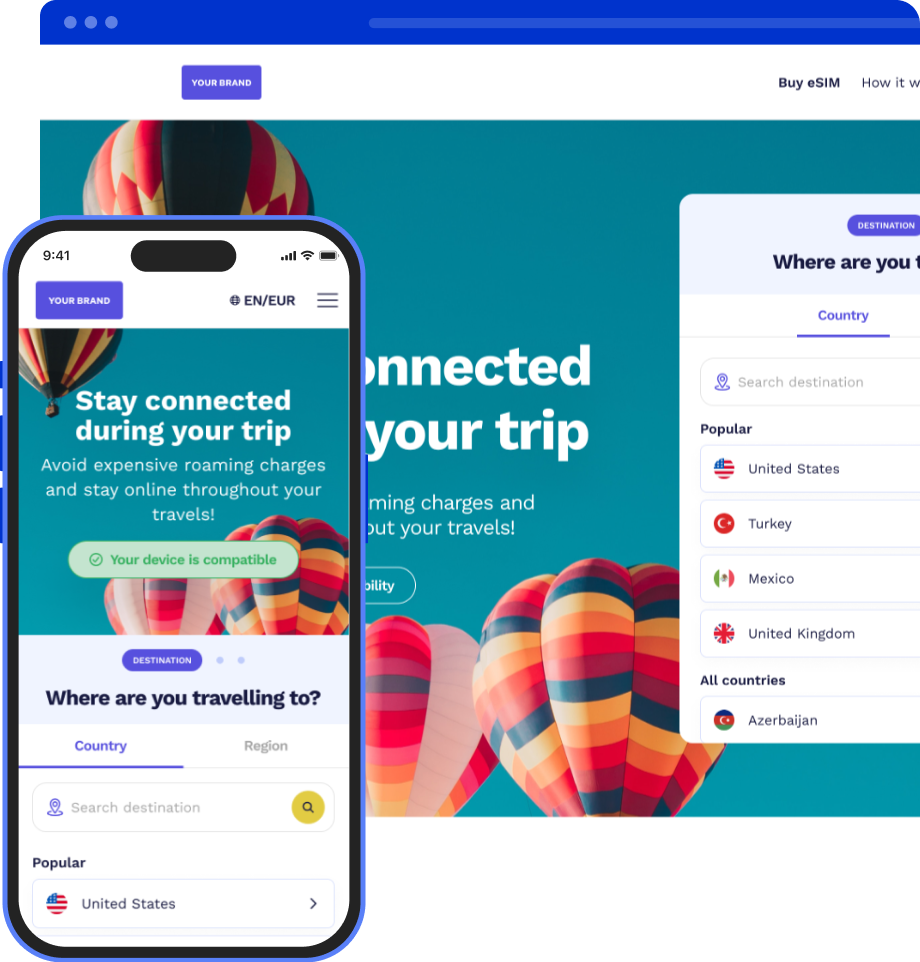

Plans that are easy to choose from
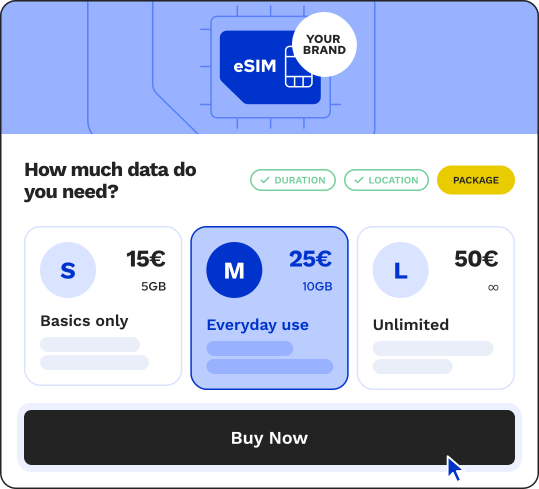
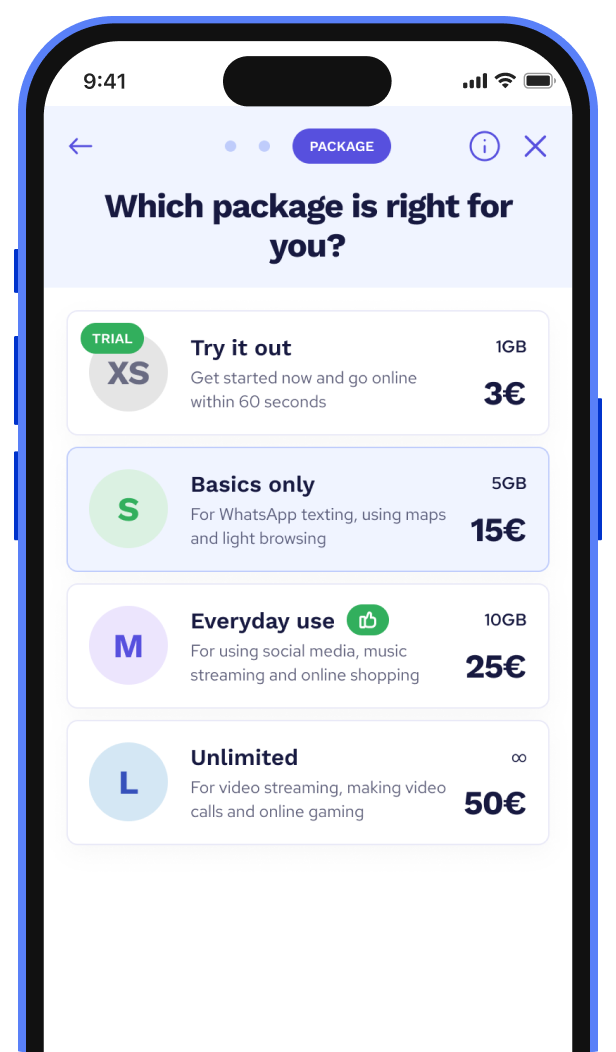
Simple S/M/L options with clear pricing. Customers decide fast and check out with confidence.

Fully branded from search to confirmation
No third-party redirects. Your brand stays consistent throughout.

Instant compatibility check before purchase
Travellers know if their device is supported before they commit. No surprises after checkout.

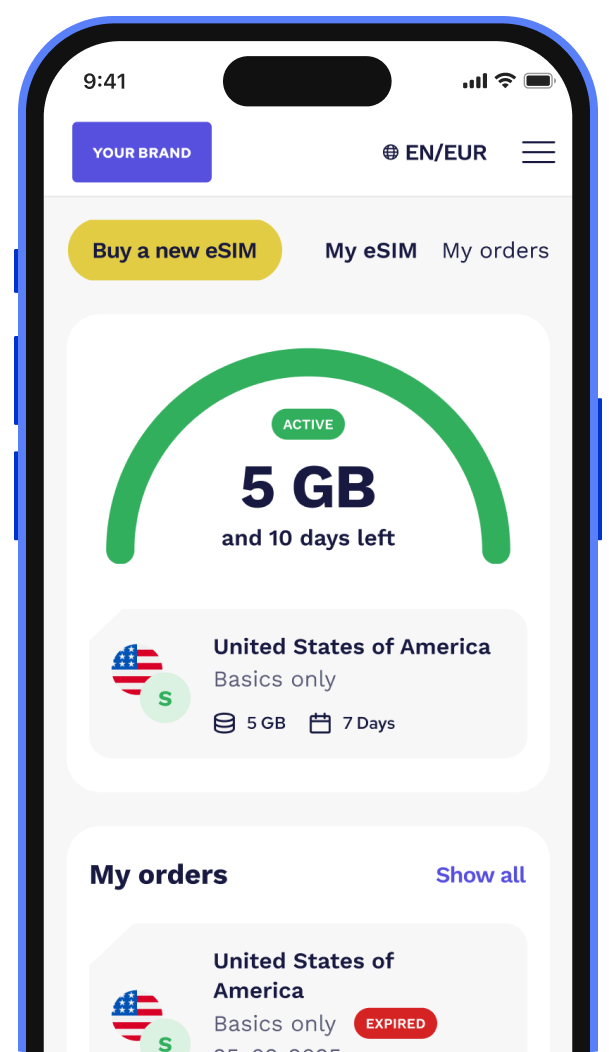
Automatic low-data alerts drive top-ups
Customers are prompted to reorder at exactly the right moment.

Reordering is faster than the first purchase
Saved details, familiar plans, one-tap checkout.

Plug into your loyalty programme
Let customers earn or redeem points for each eSIM purchase.

What is an eSIM?
An eSIM is an embedded sim built into a mobile device. Unlike a traditional sim card, it is non-removable and does not require a plastic card tray swap.
The user installs a digital mobile plan on a compatible phone, tablet or other device. The eSIM stores network credentials digitally, allowing the device to connect to mobile networks without a physical sim card.
For travel, this means passengers can buy an eSIM online, install it before departure, and use mobile data when they arrive.
How eSIM technology works for travelers
eSIM technology lets a passenger add a new plan to their device without inserting a physical card. The passenger scans a QR code, taps an activation link, or enters a manual code if needed.
The setup process usually happens inside phone settings. On many mobile devices, the user goes to mobile data, data settings or cellular settings, adds a new eSIM, and follows the setup guide.
Once installed, the travel eSIM can sit alongside the passenger’s normal phone number. This supports dual-SIM use, so the primary SIM can remain active for phone calls, receive SMS and messaging apps, while the eSIM is used for data.
Install the eSIM before the flight
Passengers can purchase and install the eSIM plan before their flight. This is one of the strongest reasons airlines are a natural distribution channel.
The airline can offer the eSIM during booking, after payment, in the app, at check-in, through the loyalty programme or in pre-departure emails. The passenger can install the eSIM while they still have a stable internet connection at home, in the airport or on Wi Fi.
An eSIM can often be installed in under two minutes. That speed makes the product easy to understand and easy to promote before the next trip.
Activation by QR code, link or manual code
The most familiar installation method is a QR code. After purchase, the passenger receives the QR code by email, app or branded store confirmation page.
The passenger scans the QR code, follows the setup process, names the new esim, and selects the right data plan for travel. If scanning is not convenient, a manual code can often be entered instead.
Some app-based flows can make the process even smoother. With in-app installation, passengers may be able to install the esim with fewer steps, reducing friction and support requests.
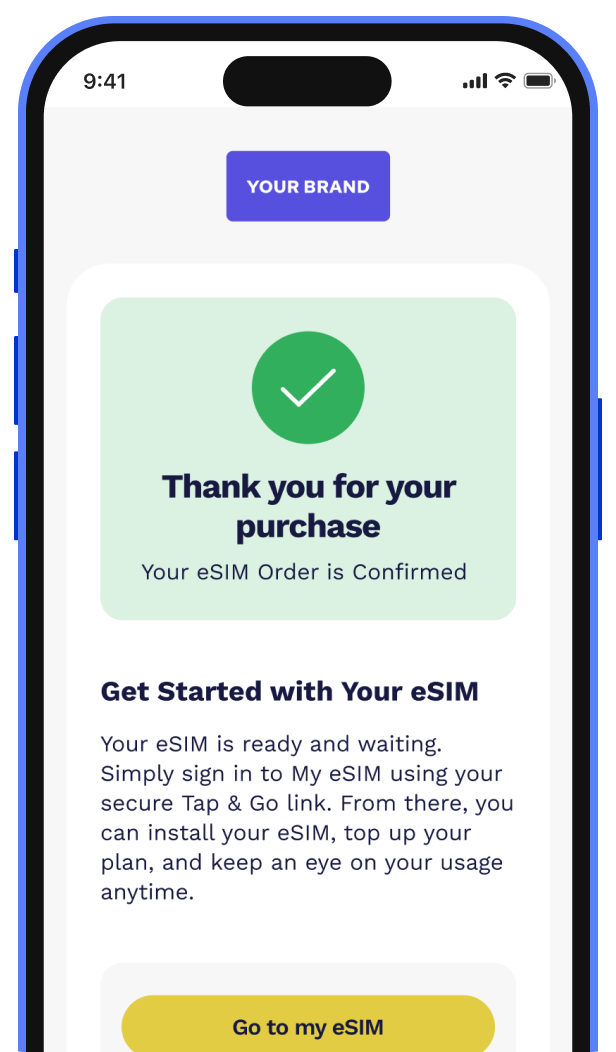
Automatic activation on arrival
Many travel eSIM products can be installed before departure and automatically activate when the phone reaches the destination and connects to a supported local network.
This is helpful for passengers because they can prepare before travel and connect automatically after landing. They do not need to wait in line for a local sim, search for a kiosk or risk surprise roaming charges.
For airlines, this makes eSIM a perfect fit for the flight journey: buy before take-off, install before arrival and connect after landing.
Built for newer mobile devices
Most newer devices support eSIM technology. This includes many modern iPhone models, Android devices, tablets and other devices that support embedded sim functionality.
Passengers can check if their device supports eSIM online before purchase. A strong airline eSIM journey should include a compatibility check, so users know whether their phone, new phone or different device can support esim before they pay.
This reduces failed orders, improves trust and lowers support volume.
Everything you need to know

Works across iPhone and Android devices
Passengers travel with many device types. Some use iPhone, others use Android devices, and some use tablets, laptops or multiple devices.
A strong eSIM provider should support clear device guidance across major operating systems. The setup guide should explain how to install the eSIM, choose the correct data settings, enable data roaming for the eSIM line if required, and avoid using the wrong plan by mistake.
Support content should also explain what to do when a customer moves to a new phone, wants to use a different device or needs help understanding whether the plan is tied to one device.

One eSIM for the whole trip
Travelers want one solution that works everywhere. A passenger visiting several European countries, South America or multiple different countries should not need to buy a separate local sim in every destination.
Airline eSIM journeys should support local, regional and global plans. Local plans work well for one country. Regional plans work well for areas such as Europe or South America. Global plans help frequent flyers and loyalty members who travel across multiple countries.
With Alphacomm, airlines can offer eSIM products across 200+ destinations, depending on the selected catalogue and commercial setup. This gives passengers one branded connectivity journey for the whole trip.

Coverage across mobile networks
Travel eSIMs connect passengers through available mobile networks in the destination. Depending on the plan and network access, the eSIM may use supported carrier networks to provide reliable mobile internet.
Some eSIM products can switch between available networks where supported. This helps passengers stay connected when coverage changes across cities, airports, hotels, rural routes or borders.
For airlines, this is an important quality point. The best esim experience is not only about affordable prices. It is about reliable coverage, simple activation and fewer passenger complaints.
Avoid roaming charges and bill shock
Roaming charges remain a major pain point for international travel. Passengers often do not know how much data they will use, how much data costs abroad, or whether background data usage will create unexpected fees.
A prepaid travel eSIM gives passengers clear data, clear validity and clear pricing before they travel. That helps reduce bill shock.
Travel eSIMs can save passengers significantly compared with standard roaming charges. Some market estimates position travel eSIM savings at up to 90% versus traditional roaming, depending on destination, home operator, data usage and plan size.

Transparent data pricing passengers understand
A passenger does not want a telecom puzzle. They want to know the country, how much data is included, how many days the plan lasts and what the price is.
Travel eSIM plans in the market can start from low entry prices, including budget-friendly options around a few euros or dollars for short trips. Some common entry-level offers begin around $3.50 for 7 days, while some daily pricing models start around €2.50 per day. These examples show why eSIM can be an affordable alternative to standard roaming, but final prices depend on the destination, plan and provider setup.
For airlines, simple plan design is essential. Passengers should be able to choose a new plan quickly without comparing too many technical options.

Unlimited data and heavy usage
Not every passenger uses data the same way. Some only need maps and messaging. Others use video calls, work tools, cloud documents, social media, hotspot tethering and streaming.
That is why airlines may want to offer both capped data plans and unlimited data plans. Unlimited data can be valuable for business travelers, families, digital workers and heavy mobile internet users.
Some unlimited data plans include fair-use policies, daily high-speed allowances or speed management after a threshold. If your airline offers unlimited data, the page should explain validity, hotspot rules, fair use and any limits clearly.
Support hotspot and tethering
Many travelers want to share mobile data with travel companions or connect multiple devices. This can include a laptop, tablet, second phone or child’s device.
Travel eSIMs may support tethering or hotspot capabilities depending on the destination, network and plan. For passengers, hotspot support makes one esim more valuable.
For airlines, it creates an opportunity to position higher-data or unlimited data plans for families, business travelers, groups and passengers carrying multiple devices.

Keep the primary phone number active
A travel eSIM is usually used for data, while the passenger’s normal SIM remains active. This lets the user keep their phone number for calls, receive SMS, banking verification and messaging apps.
This is especially useful during international travel. Passengers can keep essential phone calls and texts available while using eSIM data for Google Maps, airline apps, hotel apps and internet access.
For airlines, this dual-SIM benefit should be explained clearly in the setup guide. It reduces confusion about whether the customer is replacing their main phone service.
Offer eSIM in the booking journey
The booking journey is one of the best places to offer travel eSIM. The passenger has already chosen a destination and travel date.
That means the airline can show relevant eSIM products automatically. A flight to one country can trigger country-specific data plans. A route across several European countries can trigger regional plans. A long-haul trip can show global plans.
This turns the eSIM from a generic add-on into a contextual travel service.

Promote eSIM during check-in
Check-in is another high-intent moment. The passenger is close to departure and thinking about arrival.
A simple prompt can ask whether the passenger needs mobile data at the destination. The offer can appear in web check-in, mobile check-in, airport kiosk flows or app notifications.
This works because the need is immediate. The passenger is preparing to fly, and the value of staying connected is easy to understand.

Use airline apps and loyalty programmes
Many airlines promote eSIM through booking flows, in-flight portals, loyalty apps and post-purchase journeys. The strongest experience is often inside the airline app because the user is already logged in.
Airlines can offer eSIM as a paid ancillary, a points-redemption option, a loyalty reward, a bundled fare benefit or a destination service.
For loyalty teams, this creates a practical way to offer value beyond miles. Connectivity is useful, immediate and linked directly to the trip.
Use in-flight portals without confusing the product
Airlines generally do not build eSIM connectivity directly into the aircraft seat. A travel eSIM is not the same as in-flight Wi Fi.
In-flight Wi Fi helps passengers connect while they are on the aircraft, if available. A travel eSIM helps passengers connect on mobile networks at the destination.
The two services can work together. An airline can promote eSIM through an in-flight portal, but the mobile data plan is mainly for use after landing.
Branded eSIM store
A branded eSIM store lets your airline launch without heavy development. The passenger experiences the offer as part of your brand, not as a disconnected third-party journey.
The store can show relevant plans by destination, explain how much data the passenger may need, and guide them through purchase and setup.
This model is useful when an airline wants speed, control and a clean customer experience without long technical integration cycles.
API integration for airline platforms
For airlines that want deeper control, API integration can connect the eSIM offer into the airline app, web platform, loyalty system or partner portal.
The API model can support plan discovery, destination matching, checkout flows, customer account logic, voucher flows, order management and customer support processes.
This is ideal for airlines that want eSIM to feel like a native service inside the app rather than a separate storefront.
Why Alphacomm for airline eSIM?
Alphacomm helps airlines sell travel eSIM without becoming a mobile network operator. We provide the eSIM platform, connectivity catalogue, branded store, payments, fraud prevention, digital delivery and support flows.
Your airline can offer eSIM products under your own brand, while Alphacomm manages the complex back end. This includes product delivery, customer journey logic, secure checkout, digital goods expertise and service support.
The result is a faster path to market for airlines that want ancillary revenue, customer satisfaction and a future-proof connectivity offer.





Data plans for every passenger type
Different passengers need different data plans. A weekend city-break traveler may need only light data. A business traveler may need more data for email, maps, video calls and hotspot use. A family may want one plan that supports multiple devices.
A good airline eSIM portfolio should include simple options. Small plans for maps and messaging. Medium plans for everyday travel. Large or unlimited data plans for heavy users.
The plan should be easy to understand before purchase. Passengers should not need telecom knowledge to choose the right option.
Help passengers estimate how much data they need
Many travelers ask how much data is enough for a whole trip. Airlines can reduce uncertainty by giving simple guidance.For light use, mobile data may cover maps, messages, email and basic browsing.
For moderate use, passengers may need more data for social media, uploads and app usage. For heavy use, video, hotspot and work tools require larger plans.
This content can sit next to each eSIM plan to reduce decision friction and improve conversion.
Clear setup guide for fewer support tickets
A good setup guide matters. It should show passengers how to install the eSIM, where to find phone settings, how to choose the correct data settings, and when to turn on data roaming for the eSIM line.
It should also explain common issues. For example, a passenger may install the eSIM before travel but only connect after arriving in the destination. Another passenger may need to restart the phone or select the eSIM as the mobile data line.
Clear instructions reduce support volume and increase trust in the airline-branded service.

Security and convenience benefits
A digital eSIM reduces the need to handle a physical sim card in public places. It cannot be dropped, bent, swapped accidentally or stolen from a bag like a plastic local sim.
Because eSIM is digital, passengers can purchase it before travel and store it on the device. That makes it easier to manage than buying a local sim after arrival.
For airline passengers, the practical message is simple: eSIM is digital, fast and easier to manage than a traditional travel SIM purchase.
Airline revenue opportunities
Travel eSIM creates several airline revenue opportunities. It can be sold as an ancillary add-on, included in premium fares, added to holiday packages, offered as a loyalty reward or promoted through destination campaigns.
The offer can also support disruption scenarios. If passengers are delayed, rerouted or transferred, internet access helps them manage hotels, maps, transport and airline communications.
Because the product is digital, there is no physical inventory. That makes it easier to test, launch, change plans and optimize pricing over time.
FAQ
What is a travel eSIM for airlines?
A travel eSIM for airlines is a digital sim card offer that lets passengers buy mobile data for their destination before they fly. The airline promotes the plan through its website, app, booking journey, check-in flow or loyalty programme, while Alphacomm powers the branded eSIM service.
How fast can passengers install an eSIM?
Many eSIMs can be installed quickly, often in under two minutes. The passenger usually scans a QR code, taps an activation link or enters a manual code, then follows the setup process in phone settings.
Do eSIMs activate automatically on arrival?
Many travel eSIMs can be installed before departure and activate once the device reaches the destination and connects to a supported mobile network. The passenger may need to set the eSIM as the mobile data line and enable the correct data settings.
Do most newer phones support eSIM?
Yes. Most newer mobile devices support eSIM technology, although compatibility depends on the phone model, carrier lock status and country. Passengers should check if their device supports eSIM online before purchase.
Can travelers keep their normal phone number?
Yes. Travel eSIMs usually support dual-SIM use. Passengers can keep their primary sim card or phone number active for phone calls, SMS and messaging apps while using the eSIM for data.
Can passengers receive SMS with a travel eSIM?
Most travel eSIM plans are data-only, so SMS usually remains on the passenger’s primary SIM. Some eSIM products include calls, texts or a phone number, but this depends on the provider, country and plan.
Can an eSIM replace a physical SIM card?
For travel data, yes. An eSIM eliminates the need to buy, collect or swap a physical sim card. However, many passengers keep their primary SIM active for calls and messages.
Can passengers use hotspot or tethering?
Many travel eSIMs support hotspot use, but this depends on the plan, destination and provider setup. Airlines should make hotspot rules clear, especially for unlimited data plans.
How much data does a passenger need?
It depends on data usage. Maps, messaging and email use less data. Video calls, streaming, hotspot and work tools need more data. A good airline eSIM journey should help passengers choose the right plan.
Can eSIM plans cover multiple countries?
Yes. Many eSIM setups can support country, regional and global plans. This is useful for passengers traveling across different countries or taking multi-stop trips. Some providers include a virtual location feature for added security.
Can airlines offer unlimited data plans?
Yes. Airlines can offer unlimited data plans where available through the selected eSIM setup. Fair-use policies, speed limits and hotspot rules should be explained clearly.
Can airlines sell eSIMs as booking add-ons?
Yes. eSIM options can be offered during booking, after purchase, during check-in, in the app, in loyalty accounts or through QR codes in customer communications.
Is this the same as in-flight Wi Fi?
No. In-flight Wi Fi is used on the aircraft. A travel eSIM is mainly used after arrival, when the passenger connects to local mobile networks in the destination.
Can Alphacomm support airline eSIM at scale?
Yes. Alphacomm helps airlines launch branded eSIM products with managed commerce, payments, fraud prevention, connectivity, support and digital delivery. Your airline owns the passenger relationship while Alphacomm powers the eSIM service.
Future-proof travel connectivity
eSIM adoption is growing because mobile devices increasingly support embedded sim technology. As more passengers use eSIM-capable phones, airlines can make connectivity part of the normal travel journey.
This creates a future-proof service layer. Today, it helps passengers avoid roaming charges. Tomorrow, it can connect loyalty experiences, destination services, travel companions, insurance, ground transport and personalized offers.
For airlines, eSIM is not only a data product. It is a digital customer relationship tool.


How Alphacomm supports airlines
Alphacomm supports airlines with a managed white-label eSIM model. We help you launch the store, package the plans, manage payments, support digital delivery and create a passenger-friendly buying journey.
Passengers can easily purchase a new esim before the next trip. They can receive the QR code by email or app, install the eSIM on one device, and use it for mobile internet in the destination country.
Your airline gets a branded connectivity product. Your passengers get affordable rates and immediate internet access. Alphacomm manages the infrastructure and service layer behind the scenes.
A complete eSIM commerce layer
Alphacomm gives airlines more than a catalogue of eSIM products. We provide the commerce layer that makes the offer work.
That includes branded storefronts, payment handling, fraud prevention, digital delivery, order management, product logic, customer support flows and integration options.
This matters because eSIM is a digital product with instant delivery. The experience must be fast, secure and reliable from purchase to activation.
Built for passenger touchpoints
A travel eSIM can be promoted across the full airline journey. Each touchpoint can match a different passenger need.
Before travel, passengers want affordable data and certainty. During check-in, they want speed and convenience. After arrival, they want mobile internet that works. In the loyalty app, they may want rewards, points or exclusive offers.
Alphacomm helps airlines place the eSIM where it makes sense, without forcing the passenger into a confusing external journey.

Use cases for airlines
Airlines can use travel eSIM in many ways. It can be a simple paid add-on during booking. It can be a premium benefit for business-class passengers. It can be a loyalty reward for frequent flyers. It can be a destination offer for leisure travelers.
It can also support families, travel companions and group travelers who need more data or hotspot support. For business passengers, larger plans and unlimited data options can support work during the trip.
The key is relevance. The eSIM should match the route, destination, travel date and passenger profile.
Start with a simple plan portfolio
Airlines do not need to launch with too many options. In fact, fewer choices often convert better.
A simple starting portfolio might include a small plan for light users, a medium plan for everyday travel, a large plan for business travelers and an unlimited data option where available.
Plans change over time. With Alphacomm, airlines can test destinations, pricing, bundles and promotions based on demand and performance.
Make eSIM easy to buy
A passenger should be able to easily purchase the eSIM in a few steps. The journey should explain the destination, price, validity, data allowance, activation method and refund rules.
The customer should know whether the plan is for one country, regional travel or global use. They should also know whether the plan supports hotspot, phone calls or receive SMS.
Most travel eSIM plans are data-first, so this should be clear. If calls, SMS or phone number features are not included, the page should explain that the passenger can keep their primary SIM active for those services.
Give passengers confidence before purchase
Travelers may be new to eSIM. They may ask whether their phone supports eSIM, whether the plan works on Android devices, whether it works on a new phone, or whether they can use it on multiple devices.
A good airline eSIM page should answer these questions before purchase. It should include a device checker, a setup guide, clear plan details and support information.
This builds trust and helps passengers choose the right plan for the next trip.
How may we help?
Use the contact form and one of our Revenue Geeks will be in touch shortly!